Handel and Haydn Society serves up a fiery, compelling “Messiah” at Kravis
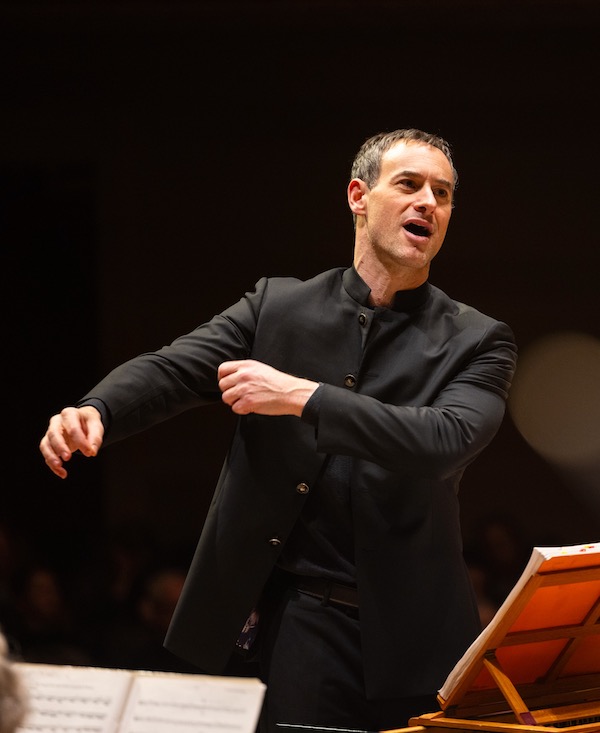
Jonathan Cohen led the Handel and Haydn Society in Handel’s Messiah Wednesday night at the Kravis Center in West Palm Beach. File photo: Robert Torres
Handel’s Messiah arrives at Christmas with the inevitability of television airings of It’s a Wonderful Life. But the performance Wednesday evening in West Palm Beach proved special.
The concert at the Kravis Center presented Handel’s oratorio virtually uncut, a rare occurrence for a work that stretches well over two hours and is often presented as a set of highlights. More important, the performance was by Boston’s renowned Handel and Haydn Society, a choral and orchestral ensemble founded in 1815—dating its origin to the presidency of James Madison and making it considerably older than the Vienna Philharmonic.
Conducted by artistic director Jonathan Cohen, the performance was unusually polished, driving and compelling in a work that can suffer from overfamiliarity and indifferent performances.
In the chorus, the different groups of voices came off with distinction and clarity in the counterpoint of “And He shall purify,” bringing off the complex interplay of voices with tonal warmth and dramatic sweep. The singers sang with ethereal lightness in “For unto us a child is born,” soaring to jubilant outbursts on the words “Wonderful” and “Counsellor.”
They sang with fire and drama over the busy orchestral accompaniment of “Surely He hath borne our griefs.” Without a trace of muddiness or blurriness, they brought choral grandeur to the drawn-out chords that ended “All we like sheep have gone astray” and to the stark, grim, unaccompanied tones of “Since by man came death.”
The most famous part of the work, of course, is the “Hallelujah” chorus. Sufficient audience members were familiar with the tradition of standing for the chorus to lead everyone else in rising from their seats as the ensemble launched into the well-known music. The Handel and Haydn Society did not disappoint, with singers, brass, drums and the rest of the orchestra giving a thumping, sonorous, weighty and emphatic performance that brought applause and cheers.
From the dark, sweeping overture through the passages of sorrow and joy, the orchestra played with accuracy, vigor and tonal richness. Period ensembles can sometimes show shaky intonation, but this one didn’t. The premium placed on intonation was apparent from the unusual amount of time the orchestra spent on tuning at the beginning of the first and second halves.
A stellar group of four singers brought maximum drama to the words of an oratorio that is often more contemplative than dramatic. Unlike many oratorios, which can feel like operas without the staging, not much actually happens in Messiah, which is drawn from English translations of the Old and New Testaments. None of the singers take on the roles of characters from the Biblical story of Jesus. The drama is in the music, and this came through with clarity and force .
The soprano Lauren Snouffer, sang with agility and graceful phrasing in the rapid notes of “Rejoice greatly, O daughter of Zion,” bringing tenderness, intimacy and a touch of operatic drama to the phrases “He shall speak peace unto the heathen.” In “I know that my redeemer liveth,” her sweet legato brought warmth and hope to this expression of religious faith.
Particularly evocative was the singing of the mezzo-soprano Avery Amereau, who brought a strong sense of drama to her arias. In “But who may abide the day of His coming,” she sang with an intensity that bordered on ferocity, without any loss of refinement or tonal accuracy, in the words “For he is like a refiner’s fire.”
In “He was despised,” she gave the aria a strong sense of theater, singing with tender lyricism the words “a man of sorrows and acquainted with grief,” rising to fiery power with the repetition of the words “despised and rejected.”
The tenor Ben Bliss gave a burnished, expressive performance. He drew out the first word in “Comfort ye,” giving the phrase emphasis that was appropriate for the opening lines of the oratorio. In the joyful tones of “Ev’ry valley shall be exalted,” he gave a dazzling account of rapid notes delivered in a single breath. He brought blazing, wrathful tones to the grim aria “Thou shalt break them with a bar of iron,” hitting the words “dash them” with particular force.
Some of the sternest tones came from the bass-baritone Nicholas Newton, singing with somber power in “Thus saith the Lord,” as well as crisp agility in the aria’s rapid passages. He could be searching and mysterious, in the opening of “For behold, darkness shall cover the earth,” sung over an effectively murmuring accompaniment in the orchestra. One of the highlights of the performance was his singing of “The trumpet shall sound,” accompanied at the front of the stage by the brilliant, distinctive sound of the Baroque trumpet played by Steven Marquardt.
In an unfortunate incident during the first half, a woman in the audience collapsed, leading the concert to stop for about 25 minutes as paramedics arrived to assist her and take her for treatment.
Experiencing a complete, or almost complete, Messiah can seem daunting. The work was composed for 18th-century attention spans, as evidenced by the number of empty seats after intermission. Yet it didn’t feel particularly long, since Messiah is so full of melody and so varied, running from expressions of Old Testament wrath to the tenderest, most searching portrayals of faith.
Violinist Itzhak Perlman performs a recital 2 p.m. December 21 at the Kravis Center. kravis.org
Posted in Uncategorized
One Response to “Handel and Haydn Society serves up a fiery, compelling “Messiah” at Kravis”
Leave a Comment
Thu Dec 4, 2025
at 12:10 pm
1 Comment


 Subscribe via RSS.
Posted Dec 05, 2025 at 3:39 pm by Debbie First
So appreciate your thoughtful, glowing review Handel’s Messiah performed by H+H — a Boston tradition that maybe will become one in South Florida. (So sorry to read
about the person who collapsed — )