Beethoven, American works open New World season with music of freedom
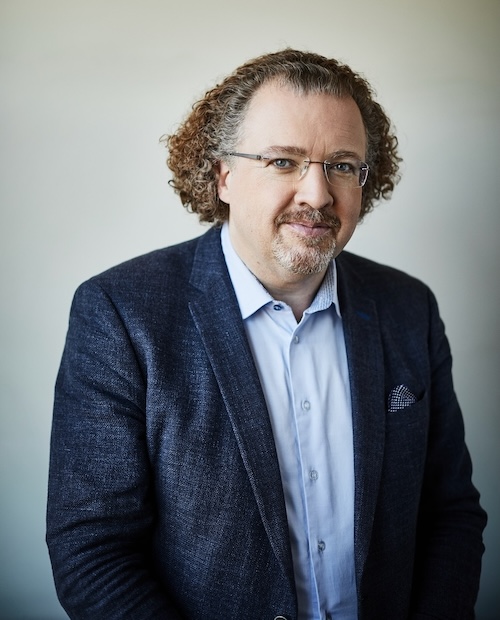
Stéphane Denève led the New World Symphony’s season-opening concert Saturday night in Miami Bach.
Heroic Americana and Beethoven’s “Eroica” symphony formed the stirring menu for the New World Symphony’s opening concert of the season.
The performance Saturday night at the New World Center began in an unconventional manner. A livestream was projected into the hall of brass and percussion fellows playing Aaron Copland’s Fanfare for the Common Man outside in Soundscape Park. Artistic director Stéphane Denève led an appropriately rousing iteration of Copland’s wartime tribute to the citizens of the home front and the players responded with sonorous power.
After greeting the audiences from the park, Denève turned things over to the orchestral academy’s new conducting fellow Zewei Ma, who led the full ensemble inside the hall in Chuphshah! Harriet’s Drive to Canaan by James Lee III.
As with previous Lee compositions played by New World, the talented American composer consistently produces expertly conceived orchestral soundscapes. The Hebrew word Chuphshah refers to freedom from slavery and the score is based on Harriet Tubman’s escape from slavery and rescue of enslaved family members and others held in bondage. Projections of Tubman and maps of pre-Civil War slave and free states added visual counterpoint to the music.
Busy wind and mallet percussion motifs opened the score but its core was a quiet section in which haunting strands of melody flowed from English horn and strings. Echoes of “Dixie” and “Battle Hymn of the Republic” are juxtaposed singly and on top of each other in Charles Ives-ian fashion. Ma exhibited a clear baton technique and drew torrents of sound from the large instrumental contingent, the concluding section exultant. The orchestra was in top form and Lee’s appealing curtain raiser was enthusiastically received by a full house.
Copland’s Lincoln Portrait featured narration by actor Joshua Malina, best known for his role in the television series West Wing. The orchestral preamble was accompanied by projections of Lincoln, the Lincoln Memorial and excerpts from his writings and speeches not quoted in the narrative text.
Denève’s understated approach avoided blatant overemphasis, keeping Copland’s folksy themes well contoured and bringing clarity to instrumental textures. Strings emerged rich, strong and unified and the first entrance of the full brass section resounded with impact.
Malina did not appear on stage until a moment before the narrator’s first words. His straightforward delivery avoided the overacting that frequently can undercut performances and recordings of the work. Malina captured the eloquence of Lincoln’s words, which remain relevant today. The performance was greeted by a prolonged standing ovation.
Beethoven’s Symphony No. 3 in E-flat Major changed music forever. Forsaking the formal conventions and brevity of the Classical-era symphonies of Haydn and Mozart, Beethoven produced a vast canvass replete with expressive nuance and emotional turmoil. The future of the symphony would never be the same.
Denève’s interpretive approach seemed rooted in the period- performance movement, marked by taut tempos and minimal vibrato. The reading took a movement to settle in. The initial Allegro con brio was hard-driven to the point of being cold and breathless. On the positive side, sections were well balanced, the undertow of the seven basses was strongly present and details often obscured were given precise delineation.
After the first movement, Denève relaxed and the performance came into focus. He achieved a natural, steady sense of flow in the Marcia funebre. Robert Diaz’s oboe solos were phrased with great musicality and a wealth of tone. The exuberant rhythm of the Scherzo was emphatically registered and Denève shaped the trio with spaciousness and heft. The tricky horn parts were fully in sync and played with spot-on accuracy.
A welcome sense of graciousness was injected into the finale. The main theme, taken from Beethoven’s ballet score The Creatures of Prometheus, was vigorously stated. Each of the variations were given individual character yet Denève did not allow the movement to become episodic. For once, the coda resounded organically and triumphantly rather than as an anticlimax. Throughout the performance, Denève drew first-rate playing from the musicians.
The New World Symphony repeats the program 2 p.m. Sunday at the New World Center in Miami Beach. nws.edu
Posted in Performances
Leave a Comment
Sun Oct 5, 2025
at 12:32 pm
No Comments


 Subscribe via RSS.