Schwarz leads Frost Symphony in an energetic and eclectic program
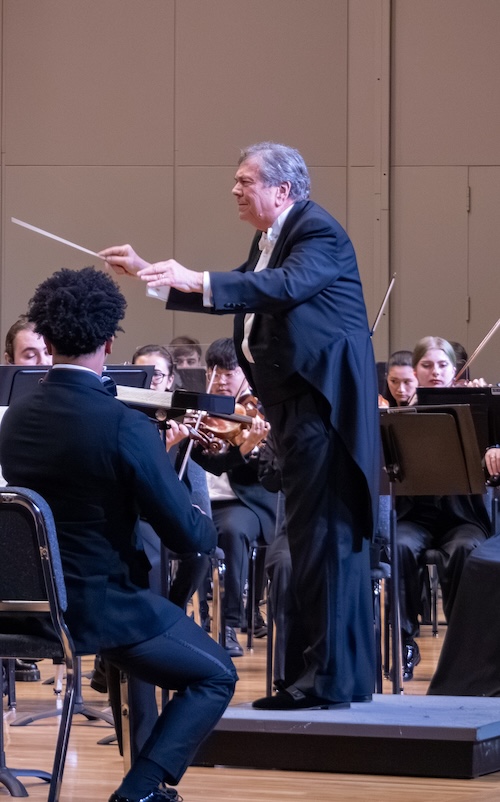
Gerard Schwarz conducted the Frost Symphony Orchestra Saturday night at Gusman Concert Hall. File photo: Savannah Methner
A kaleidoscope of musical modernity, balletic drama, and a jazz portrait of New York were the components of the University of Miami’s Frost Symphony Orchestra concert on Saturday night. At the school’s Gusman Concert Hall, music director Gerard Schwarz led new and recent works by Augusta Read Thomas and Etienne Charles and excerpts from a dance classic. The sheer size of the ensemble sometimes clashed with the hall’s very live acoustic, and climaxes, at times were ear-shattering. Still, the quality of the music making and the contemporary scores proved rewarding.
Thomas’ Hieroglyphics, a Frost centennial commission received its world premiere at this concert. The skillfully constructed score is a a densely packed fantasia of sound waves and stylistic progressions. The works opens in striking fashion with chords for winds and mallet and metal percussion. While the composer subtitled her piece “Homage to Count Basie,” there are no direct references to that jazz icon’s oeuvre. Suggestions of Stravinsky in Le Sacre du Printemps mode, big band riffs and Latin rhythms make appearances over its 13-minute duration. Schwarz was in total command of the work’s myriad changes of meter. The Frost students met all the challenges of Thomas’ complex vignette, especially the hard-working brass.
While the suites from Prokofiev’s ballet Romeo and Juliet are repertoire standards, Schwarz’s reading of five movements demonstrated his ability to make even the most familiar music sound fresh and revitalized. His brisk pacing of “Montagues and Capulets” highlighted the precision of the student ensemble’s strings and the solidity of the brass. Skittering figurations and an agile solo flute illuminated the vivaciousness of “The Young Juliet.” Schwarz projected the Russian spirit of the “Dance” section and brought out subtle details of Prokofiev’s panoramic orchestration. He drew a lustrous, full-bodied sonority from the orchestra in the grandly romantic pas de deux of “Romeo and Juliet.”
Despite the hall’s brightness, a splendid variety of dynamics was achieved. Schwarz generated lightness tinged with an undercurrent of menace in the sword-fight music leading to the “Death of Tybalt,” with the final repetitive motif resounding powerfully. The audience response was so enthusiastic that Schwarz was recalled to the stage even after the lights in the auditorium were turned up.
After intermission, the program offered the second part of jazz trumpeter and Frost faculty member Etienne Charles’ San Juan Hill – A New York Story. Commissioned for the opening of the renovated David Geffen Hall at New York’s Lincoln Center in 2022, the ten-movement suite combines Charles’ band Creole Soul with a large orchestra. The first five movements, which are for the band alone, were not performed.
Without hearing the entire composition, one can only offer comment on the final five sections that were presented. A few parts could benefit from editing, but Charles seems to have achieved the tricky fusion of jazz and the symphonic worlds successfully. Unlike many similar attempts at mixing the two genres, the orchestral role is vital to the musical discourse and does not emerge as merely pasted on. (Charles, Schwarz and the Frost students will perform the complete version at Lincoln Center on October 23.)
The work’s title refers to the neighborhood on New York’s west side that was demolished to build the Lincoln Center campus. The area’s multi-racial population often clashed and Charles painted that tension in “Riot – 1905.” (The gang violence between the Jets and the Sharks in West Side Story is partly based on San Juan Hill’s history.) Charles’ distinctive trumpet dexterity is easily the equal of such jazz legends as Louis Armstrong and Wynton Marsalis. He can make the instrument wail, sing or blaze to stunning effect . His band roster of piano, guitar, sax, flute, bass and drums are his equals. With a nod to Bernstein, the riot music melded tart thematic fragments with blasts of orchestral firepower.
An extended bluesy trumpet solo illustrated “The Negro Enchantress – The Story of Hannah Elias.” The toe-tapping dance rhythms of “Charleston at the Jungles” (a tribute to the area’s jazz clubs) were infectious.
Schwarz and the musicians were just as idiomatic and in the groove as Charles and his group. A driving pulse, aided by guitar licks, is the force behind “Urban Removal” (a cryptic reference to the urban renewal policies of controversial New York official Robert Moses). The concluding “House Rent Party” is a cavalcade of the dances throughout the century’s history—the waltz, swing, mambo, calypso, even hip-hop—and a joyous finale it is indeed. Charles, his band and Schwarz and the students generated energy aplenty.
The Frost Symphony Orchestra with Creole Soul plays San Juan Hill – A New York Story 7:30 p.m. October 23 at Alice Tully Hall, Lincoln Center in New York. lincolncenter.org
Gerard Schwarz conducts the Frost Symphony Orchestra in Alexander Panufnik’s Sinfonia Sacra, the premiere of Devin Cholodenko’s Do the Angels in the Sky Sing to the Moon?, Dvořák’s Symphony No. 8 and a Beethoven concerto and student pianist TBA 7:30 p.m. November 15 at UM Gusman Concert Hall. music.um.edu
Posted in Performances
Leave a Comment
Sun Oct 19, 2025
at 12:57 pm
No Comments
 Subscribe via RSS.