From Paganini to Piazzolla, guitarist Vieaux leads offbeat program for Chamber Music Society of Palm Beach
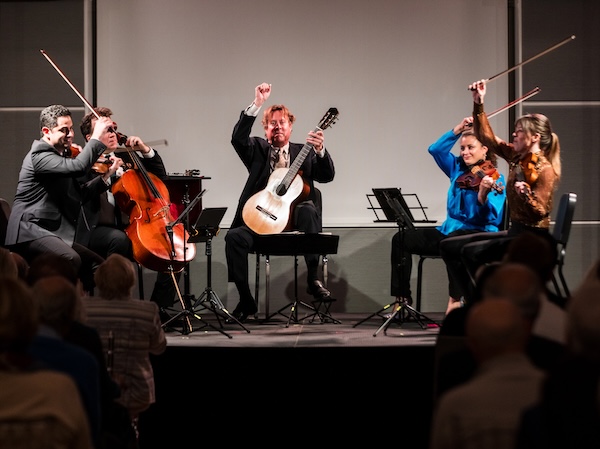
The Chamber Music Society of Palm Beach performed Thursday night at the Norton Museum in Palm Beach. Photo: Brian Larrabee
The racy tango music of Astor Piazzolla provided the highlight Thursday evening in an unusual concert at the Norton Museum of Art.
Although the term chamber music usually suggests trios, string quartets or a piano quartet, the concert in West Palm Beach focused on the guitar. The American guitarist Jason Vieaux, Grammy winner, co-founder of the guitar department at the Curtis Institute of Music and one of the instrument’s leading virtuosos, led the concert presented by the Chamber Music Society of Palm Beach.
The performance of works by Paganini, Leclair, Piazzolla and Boccherini was lighter in tone and style than the typical chamber music program. The presence of the guitar led to a natural emphasis on music from some of the instrument’s strongholds in Italy, Spain and Argentina, where dance and popular song inspired many composers.
The concert opened with Niccolò Paganini’s Terzetto Concertante in D Major for viola, cello and guitar. Although known as one of history’s greatest violin virtuosos, Paganini was also an excellent guitarist.
The music resembled that of the bel canto opera composers such as Bellini and Donizetti who were Paganini’s contemporaries, just not quite as melodically interesting. Violist Milena Pajaro-van de Stadt and cellist Edward Arron both played in a warm, assertive manner throughout the first movement.
The great guitarist Andrés Segiovia famously described the guitar as an orchestra viewed through the wrong end of a telescope. In this case, the instrument functioned not as an orchestra seen through the wrong end, but a grand piano. On the guitar, Vieaux provided harmonic support and a sturdy percussive texture, taking on the role of the piano in its chamber works with string instruments.
He played the melodies with varied colors. Full of rapid passages and harmonic complexity, the intricate guitar part came closest to Paganini’s virtuoso violin music in its demands on the performer.
A violin duet by the French Baroque composer Jean-Marie Leclair provided the opportunity for some luxury casting, at least in terms of instruments.
Violinist Arnaud Sussmann, the Chamber Music Society’s artistic director, announced that he would play a Stradivarius violin made in 1731 and violinist Tessa Lark would play a Guarnerius made in 1730 for Leclair’s Sonata for Two Violins, Op. 3, no.5. These two small instruments filled the room with rich sound–plush and singing in the upper register, throaty and assertive in the lower strings.
Most credit for the lively, polished performance of this work, of course, goes to the performers. They brought contrapuntal vigor to the opening movement, grace and passion to the haunting Andante, and a dignity and force to the concluding Presto.
Musically the most rewarding piece on the program was Piazzolla’s Histoire du Tango, a four-movement work intended to illustrate the dance’s migration from the rough taverns of Buenos Aires to cafés, nightclubs and the modern concert stage.
Violinist Tessa Lark showed a real feel for this fusion of genres. Although she brought a high level of virtuosity to the rapid, intricate bowing demanded by the work, she never played in the overly refined manner of a classically trained musician slumming in less respectable repertoire. Her playing crackled with energy and abandon in Piazzolla’s distinctive rhythms. In melodies that went high up the instrument’s highest and lowest strings, she played with smoky intensity.
On the guitar, Vieaux provided percussion and harmonic accompaniment to the violinist’s flights of high emotion. He brought a nostalgic charm to the opening melody of the café movement. And throughout, he played in a free manner that recalled the music’s origins on the dance floor.
The Classical-era Italian composer Luigi Boccherini spent most of his career in Spain, the guitar’s heartland.
His Quintet No. 4 “Fandango,” gives the instrument a prominent role alongside two violins, a viola and a cello. While the first three movements are pleasant enough, the work really comes to life in the concluding dance movement from which it got its name.
In a repeated sequence of harmonies, the dance music rises and falls in volume and intensity, building up and then fading away. With its strong drive, glissandos and intensity, the movement felt a world away from the polite Classical tone of the earlier movements. Much of the vigor came from the sturdy rhythmic grid of Vieaux’s guitar, along with a pair of castanets gamely deployed by cellist Arron.
One minor complaint: The straight-back chairs at the Norton were a trial to sit still in, particularly for a concert with no intermission.
The next concert by the Chamber Music Society of Palm Beach will be at 7 p.m. Jan. 10, 2026 at the Norton Museum in West Palm Beach. The concert will feature four string players in the society’s Rising Artists Program along with CMSPB musicians in Strauss’ Sextet from Capriccio, Beethoven’s String Quartet Op. 95 “Serioso” and Dvořák’s Sextet in A Major, Op. 48. cmspb.org
Posted in Uncategorized
Leave a Comment
Fri Dec 12, 2025
at 12:27 pm
No Comments
 Subscribe via RSS.