Honeck returns to New World with witty Haydn and soulful Mahler
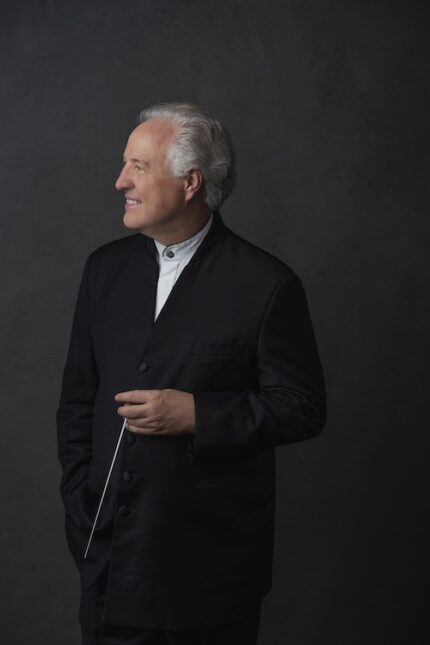
Manfred Honeck conducted the New World Symphony Saturday night in Miami Beach. Photo: Todd Rosenberg
Manfred Honeck is a superb interpreter of the core Central European orchestral repertoire. For the past 18 years, the Austrian conductor has been music director of the Pittsburgh Symphony, receiving acclaim for many recordings and international tours.
In his first appearance on the podium of the New World Symphony since 2011, Honeck led a program of works by Johann Strauss II, Haydn and Mahler on Saturday night at New World Center. The resulting music-making registered in deeply probing and enlightening fashion.
There was effervescent lightness and spirit in the Overture to Die Fledermaus by Strauss. Those slight hesitations in the waltz rhythms were perfectly articulated in the authentic Viennese manner. A speedy coda that really sparkled capped this irresistible opening appetizer.
Over the years, too few Haydn symphonies have graced New World programming so Honeck’s performance of the Symphony No. 93 in D Major was doubly welcome. Honeck’s orchestral layout proved ideal for this opus by the father of the symphony. With violins divided across the stage, violas and cellos in the middle, four basses on the left and timpani on the right, the instrumental choirs emerged well balanced with details given clarity. The symphony’s stern opening chords resounded decisively and Honeck brought gravitas to the slow introduction. He captured the wit and quirky overtones of the Allegro assai in a robust manner. The unity and precision of the strings was especially impressive.
A leisurely approach to the main theme of the Largo cantabile made the sudden shock of the brass and timpani interjections that much more potent. Throughout the second movement, Honeck’s sense of rhythm was steady and exacting. The bassoon’s sudden blast amid a quiet passage came off with as an adroit tongue-in-cheek surprise.
A brisk, enlivening Menuetto spotlighted the timpani’s vital supporting role. Honeck fully captured the humor of the Presto ma con troppo in a reading both incisive and rollicking. All sections of the ensemble responded to the conductor’s high-spirited perusal of this first of Haydn’s London symphonies with playing at peak form.
The concert’s fizzy first half served as prelude to an exceptional performance of Mahler’s Symphony No. 4 in G Major following intermission. This symphony represents Mahler at his sunniest and most serene. The composer’s markings for the four movements include such commands as “deliberately, not rushed” and “without haste.” Honeck’s vision of the score had a special leisurely, gemütlichkeit spirit. There was charm aplenty in the melodic pages of the first movement but the darker clouds of the martial strains in the central section were also fully accounted for. The depth of sonority that Honeck drew from the violas and cellos was exceptional.
The eerie surface patina of the second movement was given proper macabre resonance. Honeck’s command of balances and changing meters in this tricky section was masterful. Concertmaster Erina Buckholz played the grim reaper’s fiddle, tuned a step higher, with accuracy and finely supple musicianship.
The 20-minute slow movement is the symphony’s emotive heart. Beginning at the edge of audibility, Honeck shaped the varied contrasts of dynamics with a firm hand. Paced in an unhurried span, Mahler’s long, soulful lyrical threads emerged in a natural and organic manner. Violin lines were spun like silk and the big climax, with five horns and three trumpets at full power, registered with maximum impact.

Soprano Lauren Snouffer was the soloist in the finale of Mahler’s Symphony No. 4.
For the final movement, Mahler turned to a song he had previously written, “Das himmlische Leben” (The Heavenly Life), which offers a child’s vision of a feast in heaven, presided over and prepared by the saints. Soprano Lauren Snouffer is a familiar figure locally from her performances with Seraphic Fire and the Master Chorale of South Florida. Her high, light voice and clear top tones, matched by incisive declamation, sounded appropriately heavenly.
Snouffer’s gleaming middle range and soft tones cast a spell, bringing the child’s imagined portrait vividly to life. The hushed conclusion was beautifully rendered. Honeck held his hands in the air for over a minute, allowing the silence to add to Mahler’s expression of contentment. Admirably, the audience remained quiet and refrained from applauding until he finally lowered his hands and nodded.
Honeck acknowledged many individual players and instrumental sections during the prolonged standing ovation. South Florida music lovers should not have to wait another 14 years for this stellar conductor to return.
The New World Symphony repeats the program 2 p.m. Sunday at the New World Center in Miami Beach. nws.edu
Posted in Performances
Leave a Comment
Sun Dec 14, 2025
at 11:50 am
No Comments


 Subscribe via RSS.