Outstanding singing opens Palm Beach Opera season with “La Boheme”
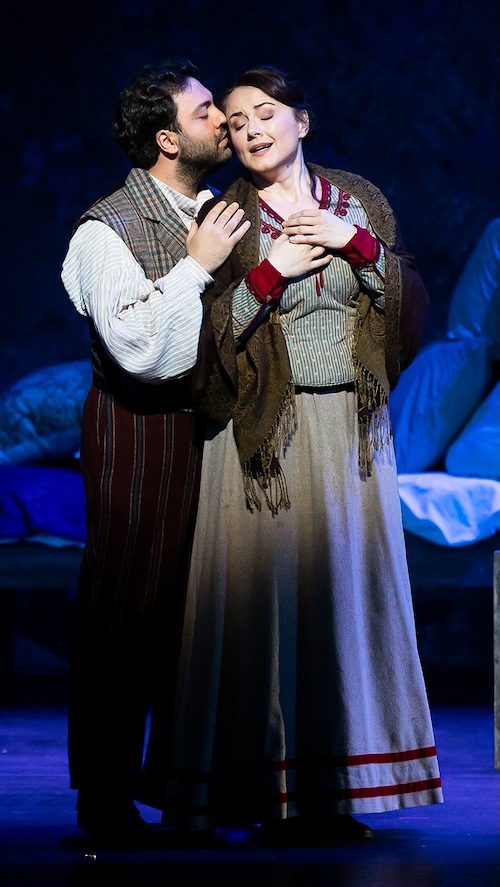
Anita Hartig and Liparit Avetisyan star in Palm Beach Opera’s production of Puccini’s La Boheme, performed Friday night at the Kravis Center.
Palm Beach Opera opened its season Friday night with what it does best: a traditional production of a popular opera with excellent singers in the leading roles.
In the company’s production of Puccini’s La Bohème at the Kravis Center, the Romanian soprano Anita Hartig gave a richly layered, passionately sung performance as the doomed seamstress Mimì, a role she has sung at New York’s Metropolitan Opera and other top houses. As her lover Rodolfo, the Armenian tenor Liparit Avetisyan matched her in vocal luster, with a raw emotional force that contrasted effectively with Hartig’s feminine ardor.
Outstanding singing has become the norm for a company that used to be more hit-or-miss, with vocal performances that once ranged from excellent to barely adequate. There is now much more consistency in the quality of the singers, as was apparent in Friday night’s performance.
The performance took place on sets that were radically traditional, throwbacks to the 19th-century Italian art of hand-painted backdrops. Constructed by the venerable Italian firm Ercole Sormani di Milano and restored by the Seattle Opera, as explained in the program, they portrayed the Bohemians’ garret with painted stairs and windows rather than the more elaborate stage constructions that are typical today.
If some audience members might have preferred a more conventionally impressive stage setting, the sets gave the production a romantically antique appearance that helped create the atmosphere of 1840s Paris. And the old-fashioned techniques achieved a surprising level of depth and realism. Particularly impressive was the second-act creation of Cafe Momus and its surrounding buildings, a busy Parisian street scene with street vendors, outdoor tables and lighted upper-floor windows.
The first encounter between Mimì and Rodolfo is one of the operatic literature’s most romantic scenes, as she knocks on his door and they find excuses to keep talking as they fall in love. Under stage director Peter Kazaras, the scene unfolded in a natural manner, as they approached each other tentatively and ended up sitting on the floor together in conversational intimacy.
Hartig, who has made a specialty of the role, was reserved, shy, even a bit formal at first. In “Sì, mi chiamano Mimì,” she sang in a manner that while vocally smooth, seemed almost hesitant, as she was gradually introducing herself to Rodolfo. So when the aria reached its climactic moment, as she sang of the beauty of the sun’s rays coming through her window, her voice bloomed into a soaring passage of self-revelation. No less effective was the quieter passage in which she sang of the beauty of her flowers, lofting high tones that floated through the hall.
Her acting was subtle and effective. As she hid behind a tree and eavesdropped on Rodolfo and Marcello in Act 3, she communicated affecting sadness as she learned she was dying. The role of Mimì will be sung on Saturday by Yunuet Laguna, with Hartig returning for the Sunday performance.
As Rodolfo, Avetisyan brought Italianate warmth and gleam to “Che gelida manina,” communicating his growing attraction to Mimì. Without losing any vocal luster, he brought anguish to his third-scene conversation with his friend Marcello, as he confessed his devastation at her impending death, singing with a desperate love and humanity. The role of Rodolfo will be sung Saturday by Oreste Cosimo, with Avetisyan returning Sunday.
The two singers complemented each other throughout, their voices intertwining in quiet intimacy and high passion as they realized their love for each other in the first-act duet “O suave fanciulla.” As Mimì lay dying, as she claimed she was recovering and he sang of hearing words from her “beloved lips,” the two singers gave everything to a soaring phrase that felt like the emotional climax of the entire opera.
Under conductor Vincenzo Milletarì, the orchestra delivered its usual excellent performance, with the polished sheen that’s essential for Puccini’s music. The musicians played with luminous tones at moments of high passion, glowing intimacy at quiet passages and stark drama at scenes such as Mimì last-act return to the artists’ garret.
As Marcello’s girlfriend Musetta, the soprano Sydney Mancasola brought unusual depth to a character often comes off as hammy and one-dimensional. In Musetta’s famous Act II Waltz, she arched silky phrases over the hall with warmth and a touch of vulnerability that belied the vanity of her words as she tried to inspire jealousy in her old boyfriend Marcello. Her last-act prayer for the dying Mimì was full of humble, beseeching compassion.
There was real chemistry among Rodolfo’s three friends, Mario Manzo as the musician Schaunard, Solomon Howard as the philosopher Colline and Edward Parks as the painter Marcello. Whether trying to make a meal out of a herring and a few pieces of bread or scheming their way out of another month’s rent, they convincingly brought to life the uniquely Bohemian combination of youthful high spirits, artistic sensitivity and impending insolvency.
By far the largest role of the three belonged to Parks as Marcello. He convincingly portrayed Marcello’s torn emotions in his fraught relationship with Musetta and his determination to be a loyal friend to Rodolfo, singing in burnished tones with Rodolfo and Musetta in Act 3 and with warmth and compassion in the last act.
As the philosopher Colline, the bass Solomon Howard brought a particularly funereal tone to the last act aria in which he says farewell to the old coat he decided to sell to help Mimì, singing the solemn words in a sonorous tone.
The baritone Donald Maxwell provided subtle comic turns as the two hapless old men who suffer humiliation and financial damage at the hands of the Bohemians. In mutton chops, he was addled and confused as the landlord Benoît. And in Act 2, as Musetta’s sugar daddy Alcindoro, he trailed behind her, overburdened with packages and generated surprising sympathy as the target of her teasing.
Palm Beach Opera will repeat La Bohème 7:30 p.m. Saturday and 2 p.m. Sunday at the Kravis Center in West Palm Beach. On Saturday the starring roles will be sung by Yunuet Laguna and Oreste Cosimo. pbopera.org
Posted in Performances
Leave a Comment
Sat Jan 24, 2026
at 11:55 am
No Comments
 Subscribe via RSS.