New World goes Hollywood with Hadelich a highlight in Korngold
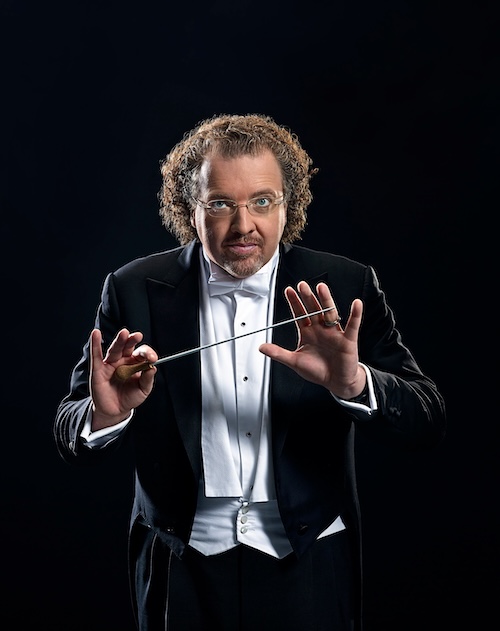
Stéphane Denève conducted the New World Symphony in a program titled “The Hollywood Sound” Saturday night.
The New World Symphony celebrated “The Hollywood Sound” Saturday night with music from the cinema’s golden age and film and still pictures projected onto the area above the stage and on the side walls of the New World Center. A world-class soloist playing a motion picture-based concerto added excitement to the proceedings. Artistic director Stéphane Denève presided over the program in fine form.
Max Steiner was the godson of Richard Strauss and an early musical émigré to Hollywood. The program opened with the Main Theme from the 1933 epic King Kong. In remarks to the full house, Denève noted that Steiner’s score was the first for full orchestra that was synchronized to sound film. Against projections of the opening of the film and shots of the massive Kong, Fay Wray and Robert Armstrong, dissonant brass figures, brilliantly executed, proclaimed a new era for film music.
Erich Wolfgang Korngold had been a wunderkind in Vienna. Considered the successor to Mahler and Strauss, he had created a successful stream of operas, orchestral works and chamber music. The rise of Nazism brought him to California and a new career working for the studios. It is not an exaggeration to say that Steiner and Korngold created film music as audiences have come to know it.
Korngold adapted Mendelssohn’s music for the 1935 film of Shakespeare’s A Midsummer Night’s Dream, directed by famed Austrian stage director Max Reinhardt. The trailer for the film was shown, enumerating the star studied cast of the era, accompanied by Korngold’s version of the famous Wedding March, as arranged by Denève. The rich scoring was played with luster by the ensemble.
Turning to an original Korngold film creation, the overture to The Sea Hawk, a 1940 vehicle for swashbuckling star Errol Flynn, epitomized the new Hollywood musical aesthetic. With scenes from the movie projected, the stirring brass proclamations and lush love theme, given full-bodied resonance by the strings and paced spaciously by Denève, encapsulated the film’s Elizabethan-era seafaring adventure.
With the program’s video component completed, Korngold’s Violin Concerto in D Major did not veer far from the concert’s thematic basis. Melodies from four movie scores form the nucleus of the 1945 concerto’s three movements. Long a vehicle for Jascha Heifetz, who played the premiere, the piece has been taken up by many prominent violinists over recent decades.
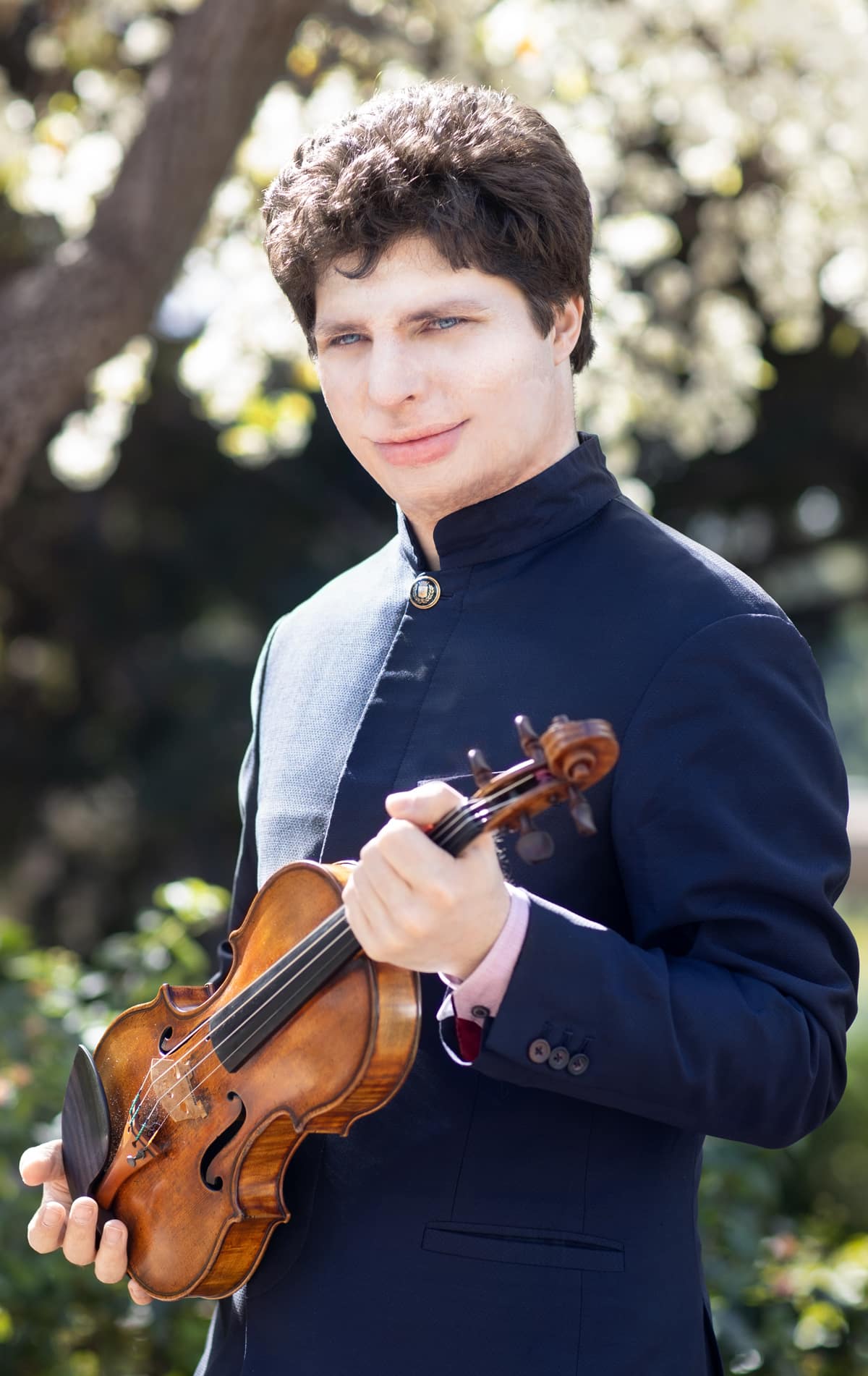
Augustin Hadelich performed Korngold’s Violin Concerto Saturday night. Photo: Suxiao Yang
Augustin Hadelich was performing the Korngold concerto for the first time (at Denève’s request) and a better pairing of soloist and vehicle could scarcely be imagined.
Unlike some players who take an objective approach to Korngold’s opus, Hadelich leaned into the concerto’s unabashed romanticism. Displaying a sterling technique, his tone soared in the secondary subject of the opening Moderato nobile. Opulent orchestral writing was given clarity and sonorous treatment. The virtuosic fireworks of the movement’s coda were played with such combustive fire by Hadelich that the final chords immediately elicited applause from both audience and conductor.
Hadelich’s tone soared in the Romance, matching the ardor of Korngold’s gorgeous theme from Anthony Adverse. Winds and harp were perfectly coordinated with the violinist’s melodic lines. In no small manner, the music’s depth of feeling and luxuriant trajectory harked back to Korngold’s Viennese roots. Hadelich’s rapid-fire bowing in the climactic Allegro assai vivace tossed off the difficult writing in the instrument’s highest reaches with aplomb. He offered a dazzling display of commanding bravura.
The audience was on its feet at the concerto’s conclusion and was not about to let Hadelich go without an encore. After repeated curtain calls, he obliged with his own arrangement of Ervin T. Rouse and Michael Cleveland’s Orange Blossom Special. Hadelich combined the idiomatic fluency of a country fiddler with the classical precision of a mature artist for a unique rendition of this country favorite. Denève watched his performance from the side of the stage and joined the listeners in applauding and recalling the violinist yet again several times.
The concert’s post-intermission half was devoted to Richard Strauss’s Also sprach Zarathustra, the opening fanfare of which was famously utilized by director Stanley Kubrick in his film 2001: A Space Odyssey.
Denève’s taut conducting prevented the tone poem’s episodic structure from becoming too diffuse. That famous opening “Sunrise” sprung from the orchestra’s lower depths to glowing brass proclamations, supported by organ, to appropriately blazing effect. The strings’ deep corporate well of sound was outstanding throughout the performance. Starting with hushed cellos, the fugal episode’s inner hues unfolded with transparent accuracy.
The enlarged brass section included seven horns, four trumpets and two tubas. With the percussion contingent and full ensemble at full power, the climax of the score’s first part was overwhelming. Sparkling winds illustrated the “Mitt humor” section.
In “Das Tanzlied” (The Dance Song), Yunjung Ko’s solo violin mixed the schmaltz of a Viennese café with the finesse of a concert artist. The incisive and vibrant string articulation illuminated the joy of the dance, a waltz breaking through the orchestral panorama. Conductor and orchestra deftly conveyed the enigmatic conclusion of “Song of the Night Wanderer.”
As in last week’s iteration of the complete score of Ravel’s Daphnis et Chloe, Denève drew outstanding playing from all sections of the ensemble. Indeed, collectively, this season’s New World fellows have performed at one of the highest levels in the orchestral academy’s 38-year history.
The New World Symphony will repeat the program 2 p.m. Sunday at the New World Center in Miami Beach. nws.edu
Posted in Performances
Leave a Comment
Sun Mar 15, 2026
at 11:11 am
No Comments
 Subscribe via RSS.