New World Symphony & Miami City Ballet team up for new work with five music premieres
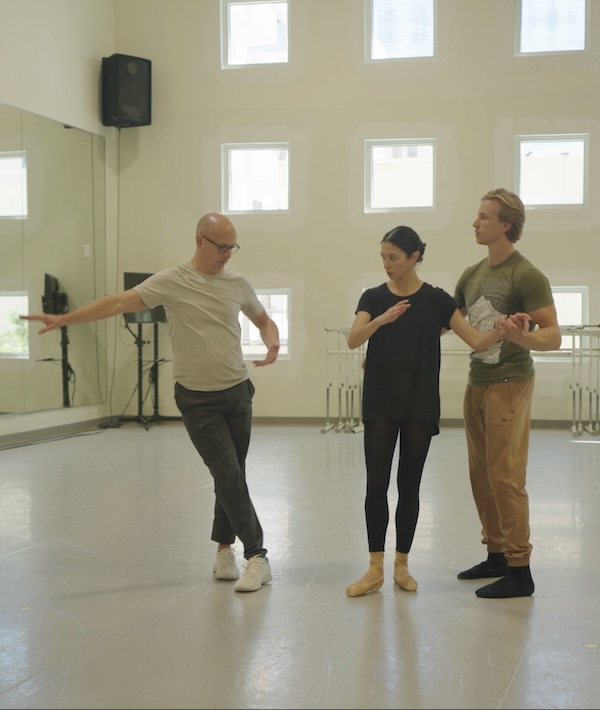
Choreographer Brian Brooks rehearses Miami City Ballet dancers Macarena Giménez and Chase Swatosh in his “Could we be Quiet?” set to Kevin Puts’ Rosalie, which will receive its world premiere with the New World Symphony Friday night. Photo: NWS Media
“There is something magical about being in conversation with a living composer,” says Claudia Schreier.
Schreier is one of five choreographers who have created new works for “American Dance Odyssey,” a joint presentation of the New World Symphony and Miami City Ballet.
The ambition project—which will be unveiled this weekend at New World Center—features a quintet of world premieres—all newly commissioned scores, three by composers who have won the Pulitzer Prize for music. The program is part of the New World Symphony’s “America at 250” celebration.
In the past, Miami City Ballet has collaborated with New World in programs of works already in its repertoire. These have included Stravinsky-Balanchine ballets (Apollo, Agon, Violin Concerto) and Robbins’ setting of Debussy’s Afternoon of a Faun, all of which were performed at New World Center with artistic director laureate Michael Tilson Thomas leading the New World fellows.
Last season, choreographer Ariel Rose and Miami-based composer Orlando Jacinto García’s pas de deux prohibido was premiered as part of the orchestra’s Resonance of Remembrance series, commemorating the eightieth anniversary of the end of World War II.
New World artistic director Stéphane Denève, who conducted those concerts, envisioned something more ambitious. “We wanted to collaborate on something new together, a Choreographic Concerto,” he explained.
Denève, who will conduct the production, conceived the Choreographic Concerto project as the balletic equivalent of an instrumental concerto with contrasting slow and fast movements. In addition to his international career on the symphonic and opera podiums, Denève has worked at the Paris Opera Ballet and the Dusseldorf Ballet with renowned French choreographers Roland Petit and Angelin Preljocaj. He recently led the St. Louis Symphony (where he is music director) in a production of Stravinsky’s Pulcinella with the St. Louis Dance Theater.
“I love ballet and love to be inspired by the dancers,” he said. In choosing the composers, he strove for different musical styles. The performances are part of Denève’s effort to expose the New World fellows to the whole spectrum of repertoire, bringing greater knowledge of opera. song cycles, choral works and dance as well as the orchestral literature.
Schreier has choreographed composer Sarah Kirkland Snider’s Iris, which opens the program.” She describes the score as “gorgeous. lush, and rhapsodic,” adding that Snider “clearly understands dance and the speed of movement.” Compose Snider says she chose the title Iris as “a flower symbol—letting in the light.” She hopes her music will “create a narrative about hope and wisdom, empathy and compassion.” Snider describes the six-minute score as combining propulsion with lyricism. She notes that the experience of writing Iris was vastly different from creating her previous 2018 ballet score Embrace, since she was allowed to compose a score and then have Schreier set the dance to her music.

Sarah Kirkland Snider’s Iris is one of five new works that make up the Choreographic Concerto.
The program’s second half spotlights a tribute to famed American choreographer Jerome Robbins. The selections will pay tribute to his varied oeuvre including excerpts from the ballets Interplay, Fancy Free, NY Export, and Opus Jazz; the musicals West Side Story, Gypsy and Billion Dollar Baby will also be represented. Twenty-seven dancers from Miami City Ballet and twelve from Houston Ballet, New York City Ballet and St. Louis Balle will perform.
Gonzalo García is in his first season as artistic director of Miami City Ballet. Although the joint project was planned by the company’s previous administration, García is highly enthusiastic about this week’s performances. A dancer and repertoire director with New York City Ballet prior to coming to Miami, García believes “this is a very special collaboration…a celebration of the past and an opportunity to give new voices a platform.”
He describes the program as “very exciting, high energy” and sees the ballet company and orchestral academy as “two organizations that think alike.” He looks forward to a continuing partnership with the orchestral academy, hoping to create a more ambitious collaboration and widen the door as part of his vision for the next chapter of the company.
Another premiere on the program, Kevin Puts’ Rosalie utilizes as its basis, a “rosalia,” an ancient term for a musical progression that is continually repeated, each time a step or half step higher. Puts, who won the Pulitzer Prize in 2012 for his opera Silent Night, says Rosalie began as a piano improvisation which he then orchestrated. He was asked to write something slow set on a certain direction but, he added, the music’s “movement increases as the energy picks up.” As compared to writing an opera where the libretto provides a composer everything needed, Puts related that it was interesting to provide a score for another artistic purpose and discipline.
Choreographer Brian Brooks has created a pas de deux titled “Could we be Quiet?” for Miami City Ballet dancers Macarena Gimenez and Chase Swatosh to Puts’ music. He considers the music “quite cinematic with a sweeping narrative, like an introspective moment in film.” With his visualization, he wants the audience “to hear the dance and see the score, blending a duality of emotions.”
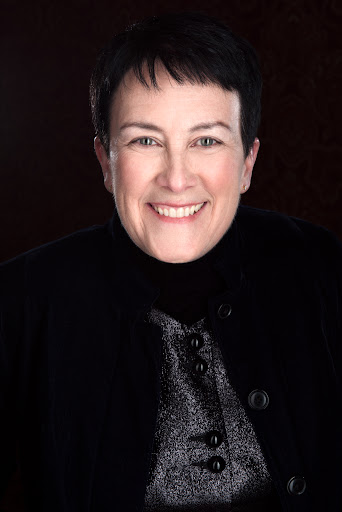
Jennifer Higdon’s Dance Measures will be the final section of the Choreographic Concerto.
Jennifer Higdon, one of the most performed of contemporary American composers, will be represented by her Dance Measures, which will conclude the five-part Choreographic Concerto. The challenge of creating Dance Measures, Higdon commented, “is making sure the ten-minute work is in danceable tempo. The pulse is very important.”
Higdon is very excited that her score will be choreographed by Tiler Peck, a veteran lead dancer at New York City Ballet. A recent PBS documentary, Suspending Time, chronicled Peck’s recovery from an injury, her return to dancing and the process of staging her first work as a choreographer. Higdon praised her “energy and focus.”
Peck jokingly remarked “this is the first work I’ve done with a composer still living.” She considers the music to be the road map on how to create motion. In the Balanchine tradition of New York City Ballet, she ascribes to putting the music first and that the dance should look the way the music sounds. Peck feels Higdon’s work has “compelling, intense energy but, from the very beginning, an ominous feeling…. fast in tempo drive, propelling forward motion.”
The Choreographic Concerto also includes Lamentations, by Jamar Roberts set to music by Carlos Simon and Polymnia from choreographer Pam Tanowitz to a score by Michaels Abels, the 2023 Pulitzer winner for the opera Omar (co-written with Rhiannon Giddens).
MCB director García praises the five new ballet scores’ diversity of styles. He is excited to see the compositions come alive, believing that “everything starts and comes from the music.” For García, “the inspiration of emotion is one of the most magical experiences.”
Denève adds “Together we can focus the imagination and create something unique and precious. The new future is happening here.”
The New World Symphony and Miami City Ballet present “American Dance Odyssey” 8 p.m. Friday and Saturday and 2 p.m. Sunday at New World Center in Miami Beach. nws.edu
Posted in Articles
Leave a Comment
Tue Apr 14, 2026
at 11:09 am
No Comments



 Subscribe via RSS.