Schwarz unearths a fascinating multi-composer American rarity with FSO
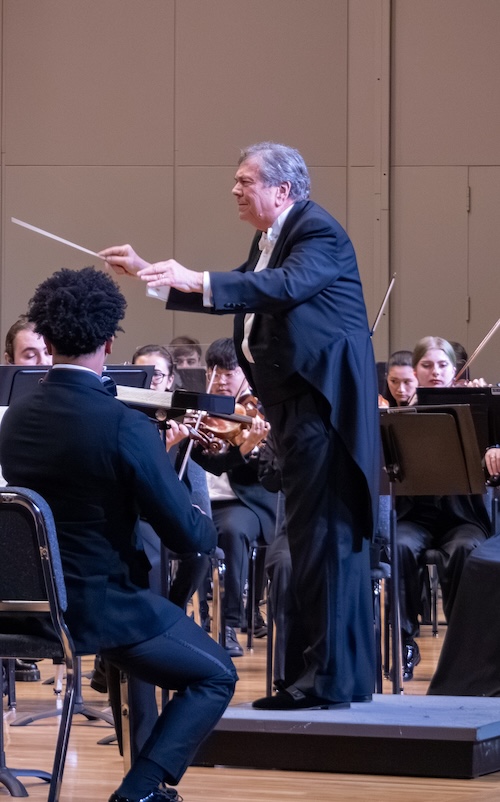
Gerard Schwarz conducted the Frost Symphony Orchestra Saturday night at Gusman Concert Hall. File photo: Savannah Methner
Gerard Schwarz can be counted on to present interesting programming, astutely balanced between standard repertoire and American music, when leading the student players of the Frost Symphony Orchestra. He also regularly inspires his youthful musicians to perform consistently above their student level.
Schwarz directed a genuine novelty on Saturday night at the University of Miami’s Gusman Concert Hall. Jubilee Variations was the conception of British conductor Sir Eugene Goossens. For the 50th anniversary of the Cincinnati Symphony Orchestra in 1944, Goossens wrote a theme and commissioned ten composers to write a variation on it, appending his own grandiose finale.
While definitely a novelty, the resulting score is far from negligible. Goossens’ fanfare-like motif makes a stirring martial opening and provides ample room for each of the composers to bring their own distinctive creative voice on the material. Schwarz provided lucid commentary and anecdotes about each of the composers, many of whom he knew personally.
Paul Creston’s initial variation encapsulates in miniature his signature rapturous lyricism with a spiky edge. Aaron Copland’s contribution is immediately recognizable for his animated Americana style.
The vignette by Deems Taylor—once well known as a radio host and classical music commentator but he far from a minor-league composer— offers lush, romantic string writing, spiced by hints of impressionism in the winds. Howard Hanson’s variation spotlights three trumpets in a lean, angular and insistent cameo.
William Schuman provides a soft, meditative canon for strings. Walter Piston added a tart, rhythmic cornucopia of brief motific cells. Roy Harris brought prairie nostalgia and glowing string and wind invention to his piece.
Less successful variations by Anis Fuleihan and Bernard Rogers suggest that those composers are justly forgotten. On the other hand, Ernest Bloch was an artist with a singular voice whose output deserves more frequent performance. Bloch’s final variation mixes bold dissonance with Hollywood soundtrack opulence. For his finale, Goossens brings contrapuntal figurations and a brassy rendition of his theme in a conclusion at top speed and volume. Schwarz drew brilliant playing from all sections in an obviously well-rehearsed performance.
Cellist Alec Doyle, a masters’ student currently studying with Ross Harbaugh at the Frost School of Music, was soloist in Tchaikovsky’s Variations on a Rococo Theme. With a lean but clear tone and fluent dexterity, Doyle nailed the score’s pyrotechnical challenges. Alert to the music’s shifting moods, Doyle brought forth the Russian sentimentality, singing line and long melodic span of the slow variations while exhibiting incisive command of his instrument in the rapid strokes of the Allegro vivo finale.
Victor Shlyakhtenko, a conducting student of Schwarz, skillfully detailed Tchaikovsky’s instrumental felicities, offering Doyle strong support. The horn solo in the introductory prelude was assayed with spot-on accuracy and the winds consistently sparkled.
Brahms’ Symphony No. 3 in F Major may be the most difficult of the composer’s four symphonic essays because of its moody discourse, both tempest tossed and warmly songful. Schwarz conveyed the work’s ambivalence, restless energy and lyrical grace.
After the brass initially overwhelmed the ensemble at the start of the first movement, the orchestra settled in and balances were adjusted. Schwarz obtained a large corporate sonority from the strings. The winds excelled in a nobly phrased Andante. Taken at a forward clip, the Poco Allegretto avoided overt bathos, Schwarz bringing surging momentum to the famous theme.
The symphony’s concluding movement can easily disintegrate in overly melodramatic, indulgent readings but Schwarz’s high-energy iteration offered vigor without undue haste. Turbulent drama and spacious relief were mixed in perfect proportion with the soft final pages the culmination of a well-conceived interpretation.
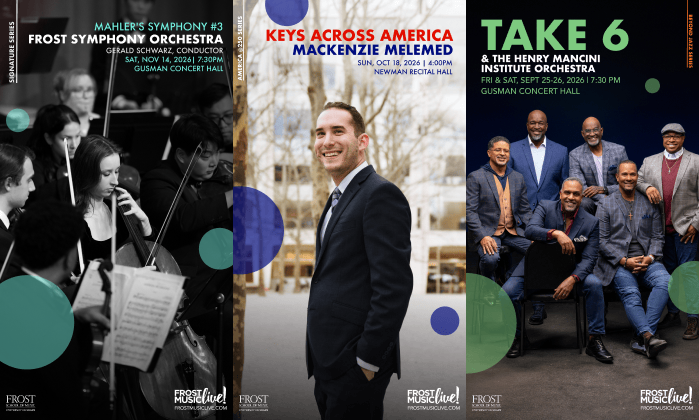
Gerard Schwarz conducts the Frost Symphony Orchestra in Mahler’s Symphony No. 3, 7:30 p.m. November 14 at UM Gusman Concert Hall. frost.miami.edu
Posted in Performances
Leave a Comment
Sun Oct 18, 2026
at 11:28 am
No Comments
 Subscribe via RSS.