Teatro Real Orchestra makes impressive Miami debut in Spanish, Russian music
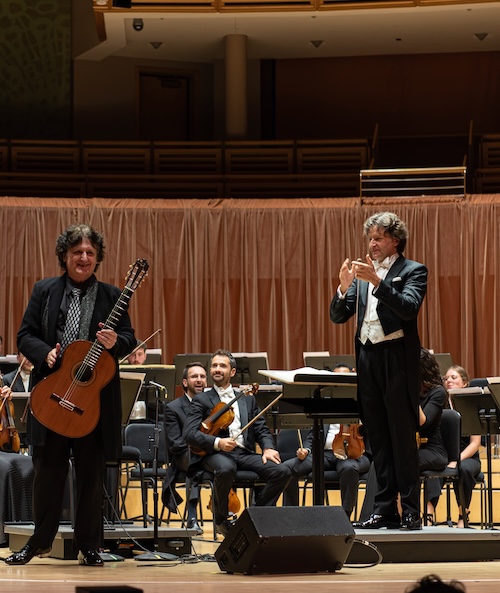
Conductor Gustavo Gimeno applauds guitarist Juan Manuel Cañizares following his performance of Rodrigo’s Concierto de Aranjuez with the Teatro Real Orchestra Saturday night at the Arsht Center. Photo: Alba Lucia Lepe Soriano
Music from Spain provided the highlights as Madrid’s Teatro Real Orchestra made its Miami debut Saturday as part of its fifth tour of the United States.
The orchestra, which serves the city’s historic opera house, appeared at the Arsht Center to perform works by Spanish composers as well as a Russian classic, in a performance before an enthusiastic audience.
The first half of the concert was devoted to Spanish music. In three works of Manuel de Falla and Joaquín Rodrigo, the tone was light and rhythmic, with the prominence of winds, brass and percussion creating distinctly different textures from the string-heavy sounds of the Austro-German repertory. The precision of the orchestra under conductor Gustavo Gimeno served the music well, with sharp attacks, rhythmic vigor and extra snap to the Spanish-inflected phrases.
The concert opened with selections from de Falla’s 1915 ballet El Amor Brujo, or “Love, the Magician,” which tells a story of jealousy, gypsies and a dead husband’s ghost. From the stark tones in brass and winds that opened the work, the orchestra gave a dramatic account. Bassoon and clarinet musicians played with sinister tones in the opening scene. In the Ritual Fire Dance, an ominous, buzzy opening in the violas, strings and winds traded a melody that grew in tension and intensity, leading to an ending in crashing, repeated chords, played with tight precision.
The Nicaraguan-American soprano Gabriella Reyes took the stage next for another de Falla work, Seven Popular Spanish Songs arranged for orchestra by Luciano Berio.
Known for her performances of Puccini and Verdi, Reyes has a rich lyric soprano voice that she used with agility and zip in some of these rustic melodies. She sang with peppy urgency in the “Seguidilla murciana” and aggressive force in “Polo,” with an articulated snap to the consonants.
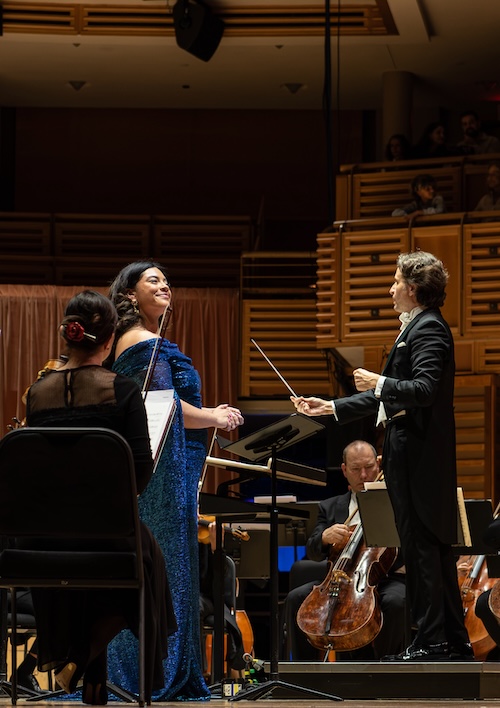
Soprano Gabriella Reyes performed with the Teatro Real Orchestra Saturday night. Photo: Alba Lucia Lepe Soriano
Not surprisingly for a singer who has specialized in roles such as Mimì from La Bohème, she was at her best in the more melodic songs. She sang with somber intensity in “Asturiana,” stretching out the melody’s climactic high note, and warm, plush tones in “Nana,” or Lullaby. Conductor Gimeno proved a skillful collaborator, drawing tones from the orchestra that supported Reyes, while tempering its volume to leave her firmly at center stage.
But her most compelling performance came in the encore, the famous zarzuela, or Spanish operetta, aria “Carceleras” from Las hijas de Zebedeo by Ruperto Chapí. In this aria of love and possessiveness, she seemed to let herself go, singing with gusto, exuberance and coquettish charm in a well-characterized performance that was full of soaring melodies. Judging from the cheers that followed, the audience would have enjoyed a program of such arias even more than the de Falla works.
The Spanish guitarist and composer Juan Manuel Cañizares performed Rodrigo’s well-known Concierto de Aranjuez.
Performances of guitar concertos are rare events, even in Miami, and the collaboration of that instrument with the orchestra brought a sensibility distinct from the more common piano or violin concertos. Cañizares skillfully teased out melodies and key harmonic tones from the guitar’s whirl of notes, blending well with the orchestra, with strings often producing crisp tones that matched the guitar.
At other points, he slashed at the guitar to produce chords of brittle percussiveness, marking a sharp and dramatic contrast to the orchestra. A highlight was the English horn solo that opened the Adagio, played with warmth and a naturalness of phrasing. In the last movement, Cañizares played the almost comically simple, rote melody with insistence and growing intensity, giving the work an effective ending.
As an encore, he gave a vigorous performance of “Cádiz” from his own Suite Al-Ándalus.
After intermission, the orchestra set aside music of Spain and turned to Russia for a performance of Rimsky-Korsakov’s epic symphonic showpiece Scheherazade. The stage management of the return to the stage wasn’t perfectly executed, and the conductor was forced to stand for several awkward minutes while patrons came in and found seats.
There’s no point in performing Scheherazade without a first-rate violinist to play the bewitching solos that portray the Persian queen who narrates the stories. In concertmaster Guergana Gergova, this performance had a real virtuoso who could do it all.
Gergova played with winsome charm and smooth tones in the seductive theme that runs through the work, brought resonance to the chords and effortless virtuosity to passages in which her bow bounced rapidly across the strings. Throughout the performance, she brought out the lyricism and grace of the music, no matter how difficult the technical demands.
In this work, the orchestra’s string section finally took center stage. In the opening movement about the sea, strings played with surging, evocative force. In the love theme of the third movement, violins played with lush sensuality. Brass plodded a bit in the aggressive figure that opens the second movement, but then played with biting aggressiveness. For solos in clarinet and bassoon, Gimeno stopped conducting and allowed the musicians to play their solos with improvisatory freedom.
This well-known work may not have been the most interesting part of a program that brought rarely heard works to the stage. But Gimeno and the orchestra gave a performance of theatrical effectiveness and orchestral virtuosity that did it justice.
Posted in Performances
Leave a Comment
Sun Oct 18, 2026
at 1:17 pm
No Comments



 Subscribe via RSS.