Intrusive ghost apart, singers deliver impressive vocalism in FGO’s “Lucia”
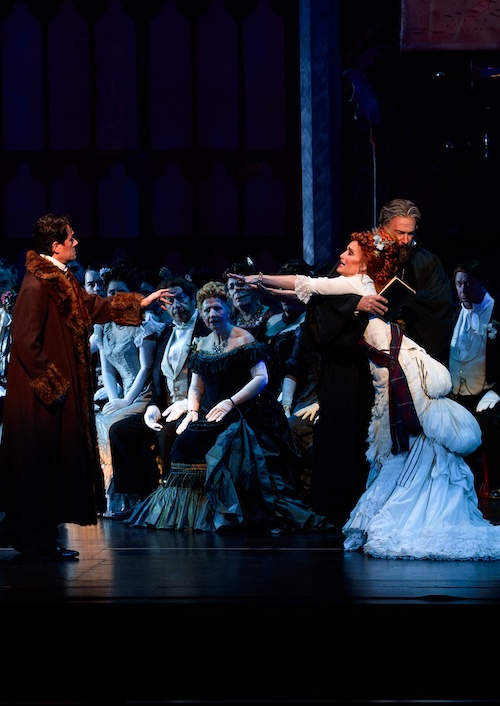
Arturo Chacón-Cruz, Marnie Breckenridge and Greer Grimsley in Donizetti’s “Lucia di Lammermoor” at Florida Grand Opera. Photo: Lewis Valdes
Donizetti’s Lucia di Lammermoor is one of the great bel canto works of the operatic repertoire. Bel canto literally means beautiful singing and there is a plethora of that in Florida Grand Opera’s current production.
Sunday’s matinee at the Arsht Center was the cast’s second performance in less than 24 hours but the singers sounded remarkably fresh, imbuing their roles with fervor and navigating Donizetti’s vocal pyrotechnics with accuracy and assurance. Only an eerie and heavy-handed directional concept marred a fine realization of this classic early 19th century opera.
Based on Sir Walter Scott’s novel The Bride of Lammermoor, the opera is a Romeo and Juliet tale of ill-fated lovers from rival Scottish clans, the Ashtons and the Ravenswoods. Lucia, an Ashton, is in love with Edgardo of Ravenswood, but is forced to marry the wealthy Lord Arturo Bucklaw by her family. Madness and tragedy ensue.
The dark secret of the Ravenswoods is that an ancestor was murdered by her suitor and Lucia believes she sees her ghost on the estate. British director Neil Robinson stages the murder to the music of the Prelude and has the ghost appear on stage as Lucia sing her first aria. All valid enough but then Robinson continually brings the ghost back, wandering the stage through the plotting and wedding festivities. In a final exaggerated stroke, the ghost removes the dagger from her heart and hands it to Edgardo to commit suicide, signaling triumph at his collapse.
Robinson’s ill-advised emphasis on the ghost’s dropping in and controlling events is overplayed by more than a few miles. That is all the more unfortunate because, in other respects, his production is admirable. He moves the drama swiftly and portrays the characters as people caught in troubled times and situations rather than stock victims and villains.
Any performance of Lucia rises or falls on the singing of the title heroine. Marnie Breckenridge combines a glamorous stage presence with a nimble lyric-coloratura soprano. Abundant warmth of tone and agility was immediately evident in Lucia’s first aria “Regnava nel silenzio” and she tossed off the trills and fireworks of the cabaletta “Quando rapito en estasi” with aplomb. In the Act II scene in which her brother Enrico shows her a forged letter supposedly from Edgardo saying he is in love with another woman, Breckenridge fully brought out the heroine’s shock and sorrow in meltingly beautiful vocal lines.
When Lucia signs the marriage contract, Breckenridge made her response “I have signed my death warrant” into a heartrending cry of pain. The famous Mad Scene is the ultimate test of the soprano’s resources and Breckenridge did not disappoint. Her secure coloratura was equal to the leaps and trills of the flute echo. She offered a poignant, fully rounded portrayal of Lucia’s mental collapse and dissolution, a display of great vocal acting rather than just musical acrobatics.
For Arturo Chacón-Cruz, singing Edgardo was a return to the lyric tenor repertoire of his early career rather than the more dramatic roles he has sung more recently. His voice is still in fine fettle. Chacón-Cruz can spin a bel canto line with subtlety or register fierce declamation as in his denunciation of Lucia when he sees the marriage contract. Still vocally fresh for the final tomb scene, his sound was sweet and evenly produced in Edgardo’s death aria. Breckenridge and Chacon-Cruz’s timbres blended to lovely effect in the duet “Verrano o te sull’aure.”
No less than two acclaimed Wagnerian singers held forth as the opera’s low voiced characters. Daniel Scofield’s powerful, rich baritone encompassed Enrico’s vehemence but also his desperation as his family’s Mafia-like empire is on the verge of collapse. Greer Grimsley, a distinguished Wotan at the Met and internationally, unfurled a voluminous bass-baritone as the priest Raimondo, dominating the stage at his every appearance. His narrative of Lucia’s disintegration and murder of Bucklaw was delivered with tonal warmth and keen dramatic intensity.
As the ill-fated bridegroom Arturo, Levi Adkins (who bears a resemblance to Luciano Pavarotti) revealed an impressive tenor with considerable heft and squillo. Alla Yarosh as Lucia’s companion Alisa had a larger mezzo sound than the comprimario singers usually cast in the role. As Enrico’s captain of the guard Normanno, Chris Melton’s light tenor and pealing high notes gave prominence to an ungrateful role.
The famous Sextet was a showstopper and for good reason. Chacón-Cruz’s opening iteration of the melody was passionate and stentorian but conductor Pablo Mielgo perfectly balanced the six voices, producing a finely contoured ensemble sound. Whether as palace guards or wedding guests, the chorus (under Jared Peroune) sang with unified, robust vigor.
Mielgo, the company’s new musical director, demonstrated a finely idiomatic sense of bel canto, accompanying the singers with grace and lightness while engendering momentum. Orchestral playing emerged secure, the solo flute a major player.
Ryan McGettigan’s handsome sets (from New Orleans Opera) and Al Crawford’s atmospheric lighting, bolstered by Erin Teachman’s projections, conveyed the Scottish venue and foreboding aura.
Despite the production’s ghostly missteps, this Lucia delivered the terrific singing that is the essence of bel canto. There is one remaining performance and vocal lovers should not miss the opportunity to hear this outstanding cast.
Florida Grand Opera repeats Lucia di Lammermoor 8 p.m. Tuesday at the Arsht Center in Miami. fgo.org
Posted in Performances
Leave a Comment
Mon Nov 16, 2026
at 2:40 pm
No Comments




 Subscribe via RSS.