Maria Todaro is working to tie FGO’s rebirth to Miami’s ascendancy
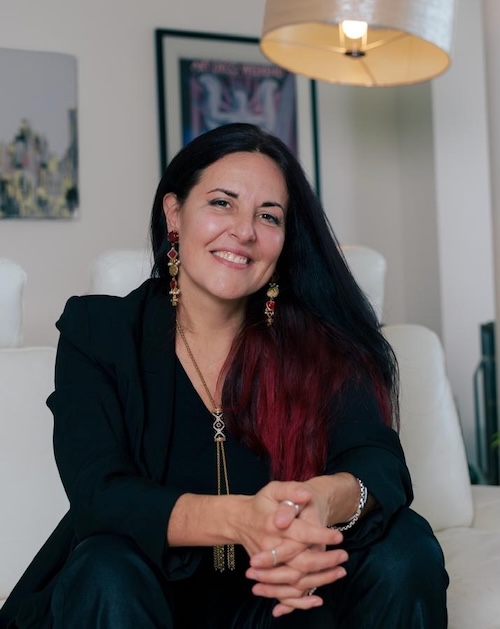
Maria Todaro, FGO’s general director and CEO, has expanded the company’s 2026-27 season, which opens Saturday with “Lucia di Lammermoor.” Photo Lewis Valdes
“Florida Grand Opera should be the pride of South Florida,” proclaims executive director Maria Todaro. “We are 35 years younger than the city of Miami.”
The venerable South Florida company will open its 85th season Saturday night with Donizetti’s Lucia di Lammermoor. And, much like the travails of that opera’s tragic heroine, FGO has faced its share of challenges and perennial financial difficulties in recent decades.
Upon arriving in 2023 as interim director, Todaro says she found the company “in much distress.” An absence of long-term planning contributed to continual deficits, with the crisis management leading to sale of the group’s properties and assets. The organization’s endowment had to be continually raided to cover costs. (The most recently available IRS filing from 2024—shortly after Todaro’s arrival—lists liabilities of $8,567,957 and an endowment of $662,272.) She said that FGO had endured “20 years of suffering.”
As she discusses plans for an expanded 2026-27 Florida Grand Opera season, Todaro says the situation is improving. She emphasizes the positive as she works toward bringing the organization to a basis of “manageable debt.” “We are rebuilding but progress does not come overnight,” said Todaro.
Yet there are encouraging signs about the company’s future including a more expansive artistic vision on the horizon.
After many years of working with pick-up ensembles arranged through third-party contractors, she has formed a house orchestra under recently appointed music director Pablo Mielgo and concertmaster Avi Nagin.Todaro has renegotiated the opera’s union contracts, bringing production costs down.
She has reached out to other Miami cultural organizations to discuss artistic and fiscal challenges. “We are very close with Miami City Ballet and the New World Symphony,” she commented and notes that she regularly meets with those organization’s executive directors.
On the artistic front, Todaro has been upgrading the company’s offerings as well. Last season she managed to bring the married opera stars Roberto Alagna and Aleksandra Kurzak to Miami for two thrilling performances of Puccini’s Turandot.)
She is also expanding the 2026-27 opera season beyond the originally announced three main-stage productions. An al fresco festival will open the new year and an intimate production of a Baroque opera will be presented.
_________
Opera has been in Todaro’s DNA almost since she was born. Both of her parents were singers – her mother the Brazilian mezzo-soprano Maria-Herera de Oliveira, her father the Italian tenor José Todaro. Celebrated operat colleagues were frequent guests in the Todaro home— Alfredo Kraus, Gino Quilico, Jon Vickers, and an aspiring young tenor named Roberto Alagna were among the luminaries who visited.
“I have been backstage since I was four years old, observing every single angle of the industry,” Todaro explained. Studying in France, she received master’s degrees in piano and conducting. Todaro led two oratorios before following her parents into the vocal realm. At around 26 years of age, she became a mezzo-soprano, singing “the Cecilia Bartoli repertoire” in European and regional American houses.
As a Rossini mezzo, she sang leading roles in The Barber of Seville, La Cenerentola and La donna del Lago. Dido in Purcell’s Dido and Aeneas and the title role in Bizet’s Carmen are among the other leading mezzo parts she has performed.
It was Bizet’s fiery gypsy that led her to directing. When she was singing the title role with the Westfield Symphony Orchestra in New Jersey, British conductor David Wroe was so impressed with her acting skills and her assistance to her colleagues that he engaged her to direct a production of Mascagni’s Cavalleria Rusticana. While it proved a challenge, she found her “passion for directing was very natural.”
Wanting to gain experience in the field, she went on to become assistant to director Bernard Uzan for the production of David di Chiera’s Cyrano at Michigan Opera Theater (now Detroit Opera) and assisted Jeffrey Buchman at the University of Miami Frost Opera Theater’s 2018 presentation of Massenet’s Cendrillon.
Buchman, who has directed FGO productions under Todaro, as well as her predecessors Susan Danis and Robert Heuer, noticed right away that Todaro “was hungry to learn, attentive to the smallest of details that opera demands.” He observed that “she had a profound love of opera and a dedication to understanding how the many elements of a production come together to serve a unified vision.”
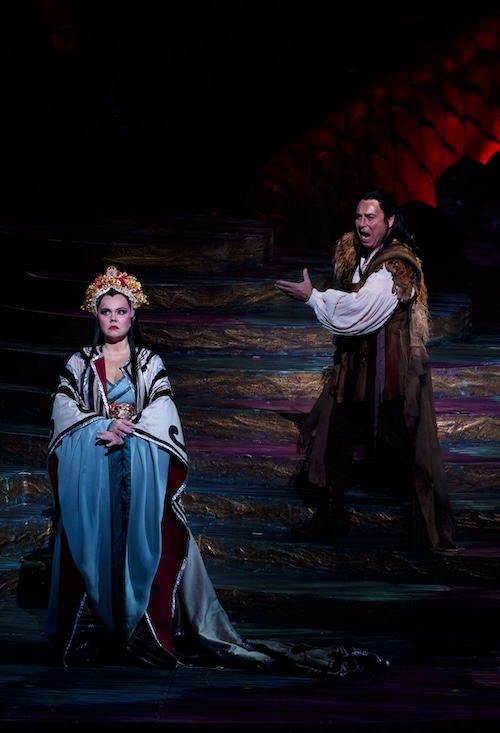
Maria Todaro was able to lure opera stars Roberto Alagna and Aleksandra Kurzak to Miami in March for FGO performances of Puccini’s Turandot. Photo: Lewis Valdes
Todaro has staged over 23 productions with American opera companies, which she continues to do, in addition to her FGO position. In 2022, she directed L’Amant Anonyme (The Anonymous Lover), the sole surviving opera by Joseph Bologne, Chevalier de Saint George) at Minnesota Opera. She has written the libretto for an operatic version of The Three Musketeers with composer Mitch Bach. The summer of 2026 marked Todaro’s debut as director and costume designer at the Puccini Festival at Torre del Lago in Viareggio, Italy with a production of Tosca. She is scheduled to direct Bellini’s Norma at Venice’s Teatro La Fenice in 2027.
In 2010, Todaro and her husband, baritone Louis Otey, relocated from the New York area to Phoenicia, a hamlet in Ulster County, two hours from New York City. Her new neighbors wanted to raise money for a playground. Todaro suggested she put together an operatic entertainment for the fundraiser. “One hundred people showed up,” Todaro recalled with many asking her to do the musical program again.
That project began her “three day model of Spoleto on a shoestring.” Christened as the Phoenicia Festival of the Voice, the event drew 3,000 people. Becoming an annual event, the renamed Hudson Valley Festival of the Voice grew to 23 events over a five-day period in multiple venues, establishing Todaro’s reputation as a producer and administrator.
Even while directing the summer project, Todaro said she and Otey “fell in love with Naples” on Florida’s southwest coast where they found restful peace and calm. In 2023, she had dinner with FGO director Susan Danis to discuss a possible production. In early September of that year, Danis abruptly resigned as the opera’s leader, feeling a new director was more appropriate for the conservative repertoire the board envisioned.
Todaro wrote a letter to the board of directors, offering her services. One of the members of the director search committee that had been formed was Larry Kamin. He had attended Todaro’s production of Leoncavallo’s Pagliacci at the Hudson Valley festival and enthusiastically supported her appointment as interim director. That position was made permanent at the end of the 2023-2024 season.
_________
After three seasons of heightened fund raising and “crisis management,” Todaro is ready to expand the company’s offerings.
“The 2026-2027 season is built to reflect the 85th anniversary of FGO and connect with its legacy,” Todaro explains. In addition to three mainstage presentations (Lucia di Lammermoor, Don Giovanni and Verdi’s first major triumph Nabucco), a Miami-centric version of Todaro’s Festival of the Voice will take place January 8-10 at Maurice Ferré Park (formerly Museum Park).
An opera in movies night will feature film clips from scenes with opera accompanied by live performances featuring singers and orchestra. A fully staged performance of Rossini’s The Barber of Seville will feature the return of Stephanie Doche, a former FGO studio artist who has gone on to a significant professional career. (Doche was the outstanding Rosina in FGO’s 2023 Barber.) “The final evening will be a surprise for the community,” Todaro says, “mixing opera with reggae, techno, all the sounds of Miami.”
February 12-13 brings an intimate production of Henry Purcell’s Baroque masterpiece Dido and Aeneas at downtown Miami’s Trinity Cathedral. Todaro will stage the opus as “an immersive opera in the round” with singers close to the audience. The presentation will give studio artists the opportunity to sing leading roles in addition to playing secondary parts and covering leads in the major productions. A Viva Verdi gala concert in Fort Lauderdale on May 1 will close out an ambitious 85th anniversary season
Looking to the future, Todaro hopes to present the top ten most popular works but also explore other musical avenues. She would like to present a Wagner opera and do a zarzuela staged as “a grand spectacle” in European fashion rather than the small-scale iteration seen previously at FGO. Todaro would also like to collaborate more with fellow regional opera companies of equal size and stature.
Todaro sees the opera as part of a larger artistic spectrum “to align Miami as comparable to New York.” The arts have long struggled to find space in the area’s image as a magnet for sports and sun-drenched beaches. She sees cooperation with other area organizations as a way to change that outmoded view of the area’s cultural life.
Buchman believes Todaro “has a clear vision for Florida Grand Opera’s next chapter and a commitment to moving both the company and the art form forward.” Todaro praises her “beautiful, dedicated team” and despite often working 16- hour days, says “I love my job!”
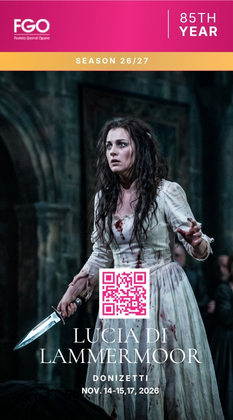
Florida Grand Opera presents Donizetti’s Lucia di Lammermoor 7 p.m. Saturday, 3 p.m. Sunday and 8 p.m. November 17 at the Arsht Center in Miami. fgo.org
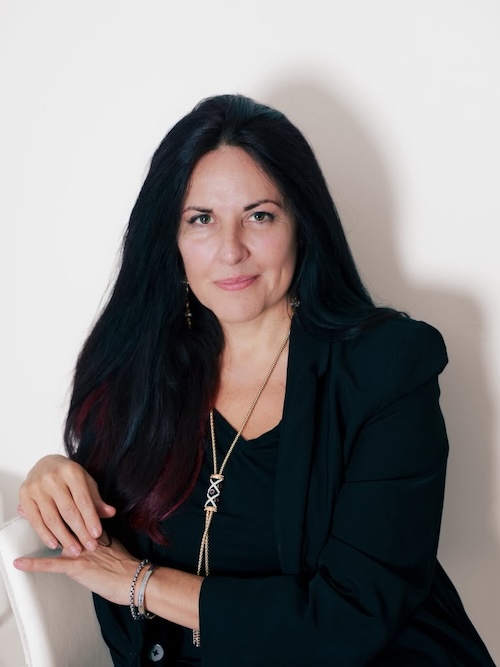
Photo: Lewis Valdes
Posted in Articles
Leave a Comment
Wed Nov 11, 2026
at 11:38 am
No Comments

 Subscribe via RSS.