Performances
Ax closes Palm Beach Symphony season in style with luminous Mozart
Emanuel Ax turns 77 next month. But at a performance Sunday […]
Master Chorale’s environmental message comes through powerfully, if not always clearly, in season finale
Nature has inspired some of the most celebrated and evocative works […]
New World Symphony wraps season with American music, MTT tribute
The legacy of conductor Michael Tilson Thomas and philanthropist Lin Arison […]
Articles
Michael Tilson Thomas 1944-2026
Michael Tilson Thomas died Wednesday at his home in the San […]
Article
CEO Herring retires from New World Symphony with record of achievement
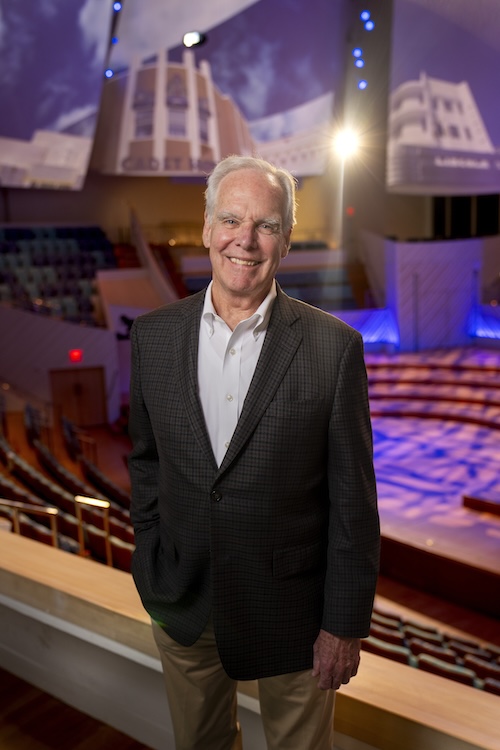
Howard Herring at New World Center, the Miami Beach venue he shepherded into existence during his 25-year tenure as president of the orchestral academy. Photo: Alex Markow
When Howard Herring applied for the position of President and CEO of the New World Symphony in late 2000, the world and Miami’s cultural scene was very different than today. Bill Clinton was President, Donald Trump was a New York developer and 9-11 was just a date on the calendar. Miami did not have an acoustically viable hall for orchestral concerts. Construction had not yet begun on the Arsht Center in downtown Miami and the New World Center, the orchestral academy ‘s home campus, was only a dream.
Herring will retire on June 30 after a quarter-century as the top executive at New World, and he has played a pivotal role in transforming the area’s cultural landscape. Following his initial interview, a conversation with artistic director Michael Tilson Thomas convinced him to take the job. He was deeply impressed by the conductor’s “commitment to excellence.”
“I have seen Miami go through fundamental changes which have been for the better,” Herring said, reflecting on his tenure. In September, 2001 when Herring first assumed his duties, the ensemble lacked a good concert facility.
Early New World Symphony seasons took place at Gusman Cultural Center on Flagler Street in Miami (where the New World fellows played in their early seasons), a venue with a dry, colorless acoustic and lack of parking.
By the time that Herring took charge, the New World Symphony was ensconced at the Lincoln Theater, a renovated 1930’s Art Deco movie house on Lincoln Road. Herring related that, in one of the theater’s cramped practice rooms, the violinists’ bows would hit the ceiling. While better than Gusman, in the theater’s main hall, the acoustic leaked refinement and detail, and large orchestral works often emerged blaring.
After fifteen years as executive director of the Caramoor Festival in Katonah, New York, Herriing found the challenges at New World encompassed both the artistic environment and the organization’s relationship to the broader community.
“As I walked down Lincoln Road and took in the relaxed, informal atmosphere, I felt the distance between Miami and the traditions of classical music,” Herring noted. He embarked on a program to bring those two worlds together.
First Herring developed a program of informal, thirty-minute concerts, sending out staff members to distribute flyers for the events. The multi-season series drew an audience of newbies to classical music who enjoyed the short, non-threatening format.
More crucially he also set about developing an agenda for the orchestral academy to “imagine the future” through 2030. Central to that agenda was the design and construction of a new hall and campus, liberating the New World fellows and audiences from the makeshift conditions of the Lincoln Theater.
Tilson Thomas and Herring envisioned a teaching, rehearsal and performing environment that would be welcoming to newcomers to symphonic music. Technology was pivotal to that goal. Live video projected on a wall with high tech audio was be a major component, welcoming a large audience in the park adjoining the hall. Herring believes that “culture builds community” and that making the arts available to the public beyond the audience in the auditorium is an important way to expand the listening base for the art form.
When Herring asked Tilson Thomas who he would like to design the project, the conductor immediately named Frank Gehry. The late Los Angeles-based architect had designed several successful performing arts buildings, including the acclaimed Disney Hall in Los Angeles. With Gehry and his design team on board, Herring said that, during repeated visits to Gehry’s Santa Monica studio, the architect insisted that his plans be challenged in order to achieve the design that would successfully accomplish the organization’s mission.
Inaugurated in January, 2011, the New World Center is a first- class concert space, combining a stunning design, superb acoustic and high-tech video facilities. The building also houses rehearsal rooms, recording facilities and a roof top space for receptions and social functions. The adjoining Soundscape Park has drawn as many as 2,000 listeners for the Wallcast performances and live webcasts have brought the orchestral academy’s concerts to a world-wide audience, marking a new era for the New World Symphony.
The successful planning and construction of the complex remains Herring’s greatest achievement, one that he accomplished without cutting corners or costs that would impact the quality of the facility and its acoustics.
Herring considers the lead up to the hall’s opening, however, as the most stressful moment of his tenure. In the summer of 2010, Herring and his staff awaited the delivery of multiple pan cameras that were essential to the projected Wallcasts. The video equipment had to be silent so as not disturb the listeners in the hall. The manufacturer promised he could provide the desired tech and that he would deliver everything by Thanksgiving. That would leave only six weeks to test the cameras before the hall’s opening night. “Would it work?” was Herring’s greatest worry. In the end, the cameras were received and, indeed, functioned well, allowing the ambitious plans to open the concerts to a wide public to succeed.
Herring is also proud of the academy’s “Blue Projects” which he helped to develop. “We developed a program that encourages the fellows to determine a concept, thinking independently.”
During Herring’s time at the organization, the number of applicants for the yearly 35 open positions in the orchestra has grown from 1,000 (with a dip to 800 post-Covid pandemic) to nearly 1,500 this year. He strongly believes that the academy “can be ever more inventive in order to find ways to engage new listeners.”
To that end, two new YouTube series have recently debuted. Modern Masterworks” features contemporary composers in conversation with artistic director Stéphane Denève as the orchestra prepares for performances of their scores. “Chasing Crescendos” focuses on individual fellows as they navigate the academy’s full panoply of masterclasses, rehearsals, special projects and concerts.
Herring says he intends to spend his time in retirement working to “help investment in cultural programs to see that they are well funded and deliver artistically.” When his yet-to-be-named successor takes up the top executive position, he will inherit an artistic dedication that Herring played a prominent role in creating.
The New World Symphony opens the 2026-2027 season with Stéphane Denève conducting Debussy’s Iberia, Ravel’s Bolero and Arturo Márquez’s Fandango with violinist Anne Akiko Meyers. Ziwei Ma leads Gabriela Ortiz’s Kauyumari. Performances are 7:30 p.m. October 3 and 2 p.m. October 4 at the New World Center in Miami Beach. nws.edu
Coming Up
September
The SFCR calendar listings will return in September. […]
News
Denève’s New World Symphony contract extended through 2032
The New World Symphony has given Stéphane Denève a strong vote […]
 Subscribe via RSS.