Quigley leads Seraphic Fire in a glorious performance of Bach’s Motets
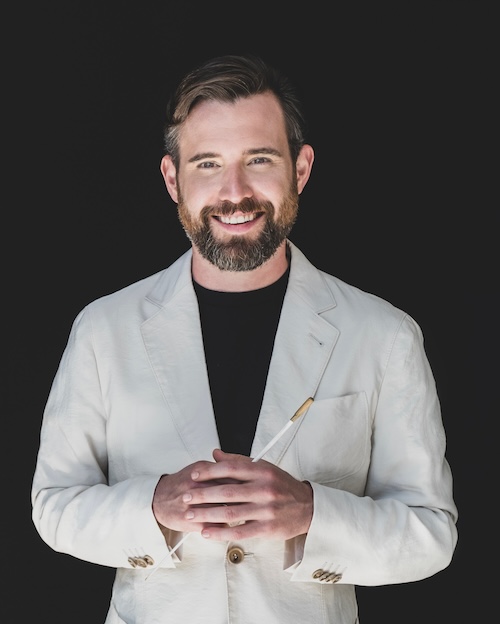
Patrick Quigley led Seraphic Fire in Bach’s Motets Friday evening in Coral Gables.
The six Motets of Johann Sebastian Bach are some of the Baroque master’s most strikingly original and adventurous creations. These scores have occupied a central place in Patrick Dupre Quigley’s 24-year tenure as co-founder and artistic director of Seraphic Fire. Bach has been Quigley’s musical high priest. His performances of the B minor Mass, passion settings and cantatas have been consistently inspired.
Quigley has led the chamber choir in the motets twice previously (in 2006 and 2017) but his reading of these gems on Friday night was his best performance yet. Larger in scale and vocal sonority than in prior iterations, the music benefited immensely from the resonant acoustic in the sanctuary of St. Philip’s Episcopal Church in Coral Gables. It was entirely appropriate that Quigley would venture these seminal Bach works for his first appearance in the final season of his directorship.
While the motets were written as individual pieces for special occasions, they make a highly satisfying offering when assayed as a set. As a note in the program booklet stated, each performance of the motets requires myriad decisions about solo verses, ensemble lines and instrumental textures. In past renditions, Quigley utilized a theorbo, organ and cello as the continuo group. This time he led 5 strings and harpsichord as backing to the vocal writing. That seemed closer to Bach performance tradition and offered a livelier, more animated aural panorama. Aya Hamada’s lively harpsichord provided especially vigorous Baroque styling and buoyancy.
Quigley noted that eight singers from Seraphic Fire’s Ensemble Artist Program at UCLA were singing these works for the first time. (The UCLA program is directed by James Bass, a long-time choir member and the group’s artistic director designate.) At full strength, Quigley deployed 20 voices and the corporate sound was glorious. Voluminous, skillfully blended and rich in tonal production, the choir sounded exceptionally fine. Just as significantly, the singers evidenced interpretive depth and careful attention to a variety of dynamic contrasts.
Quigley opened with 12 voices resounding in joyous and celebratory fashion in “Lobet den Herrn, alle Heiden” (Praise the Lord all the heavens). Bach’s setting of Psalm 117 benefited from Quigley’s lively pacing and expert coordination. As so often the case with Seraphic Fire, individual voices had clarity and definition while melding into a vibrant corporate sonority. The strings players registered incisive articulation while remaining astutely balanced with the singers. “Komm, Jesu, komm” (Come Jesus, come) was alternately solemn and uplifting. Quigley masterfully drew out all the contrasts in Bach’s sonic palette.
The contrapuntal complexities of “Singet dem Herrn ein neues Lied’ (Sing to the Lord a new song) were given a pitch-perfect rendering. The massive vocal counterpoint was clearly audible with ideal intonation. In the central Aria section, the quartet of soprano Rebecca Myers, alto Gabriela Estephanie Solis, tenor James Reese and bass John Buffett was exquisite. Myers’ angelic top range proved a particular delight. The motet’s robust final chorus represents Bach at his most festive and the full voices really soared to the heavens. It would be difficult to imagine a better performance,
The chromaticism in “Fürchte dich nicht, ich bin dir” (Do not fear, I am with you) was far ahead of its time and poses a formidable challenge to the performers. Quigley’s springy tempos and careful attention to dynamic and tonal shadings elicited superlative vocalism.
“Jesu, meine Freude” (Jesus, my joy) is based on a chorale melody that Bach deployed in numerous scores. Almost a set of variations on the chorale, the opus is consistently inventive, each new version surprising and imaginative. The initial statement of the motif was delivered with heft and simplicity of utterance. Quigley commanded the changes of meter with solidity and a knowing hand. In one brisk section, he stopped conducting, allowing the choir to sing with spirit to his evident delight. The final repetition of the principal melody proved stirring.
The flowing opening of “Der Geist hilft unsrer Schwachheit auf” (The spirit helps our weakness) went with a dance-like energy. There was expressive drama in the singers’ evocation of the holy spirit. The exceptional solo contingent of Elijah McCormack’s high soprano, Elisa Sutherland’s firm mezzo, Haitham Haidar’s velvety tenor and Edmund Milly’s strong bass were standouts. The final stately “Alleluia, alleluia” capped an evening of great singing and patrician musicianship.
Kudos to Edson Scheid de Andrade and Katie Hyun (violins), Kyle Miller (viola), Sarah Stone (cello) and Nathaniel Chase (bass) whose string playing consistently enlivened the performances. Once again, the combination of Bach with Quigley and Seraphic Fire resulted in music making of the most memorable variety. A full house awarded Quigley and the choir prolonged applause throughout the concert.
Seraphic Fire repeats the Bach Motets 7:30 p.m. Saturday at All Saints Episcopal Church in Fort Lauderdale and 4 p.m. Sunday at St. Gregory’s Episcopal Church in Boca Raton. seraphicfire.org
Posted in Performances
Leave a Comment
Sat Nov 15, 2025
at 11:07 am
No Comments
 Subscribe via RSS.